 PLAY AI 筆記
Claude Opus 5 與 Qwen3-Max:2026 年閉源模型架構、上下文與代理能力比較
Claude Opus 5 於 2026 年 7 月 24 日發布,為 Anthropic 在該時間點的前沿文字與 agent 對手模型。 Claude Fable 5.1 與 Claude Mythos 5.1 均於 2026 年 9 月 1 日發布,為同一底層模型的不同安全防護層級版本:Fable 5.1 為一般可用版,Mythos 5.1 僅透過可信存取計畫提供,主要面向資安與生命科學研究。
本篇內容

背景與脈絡
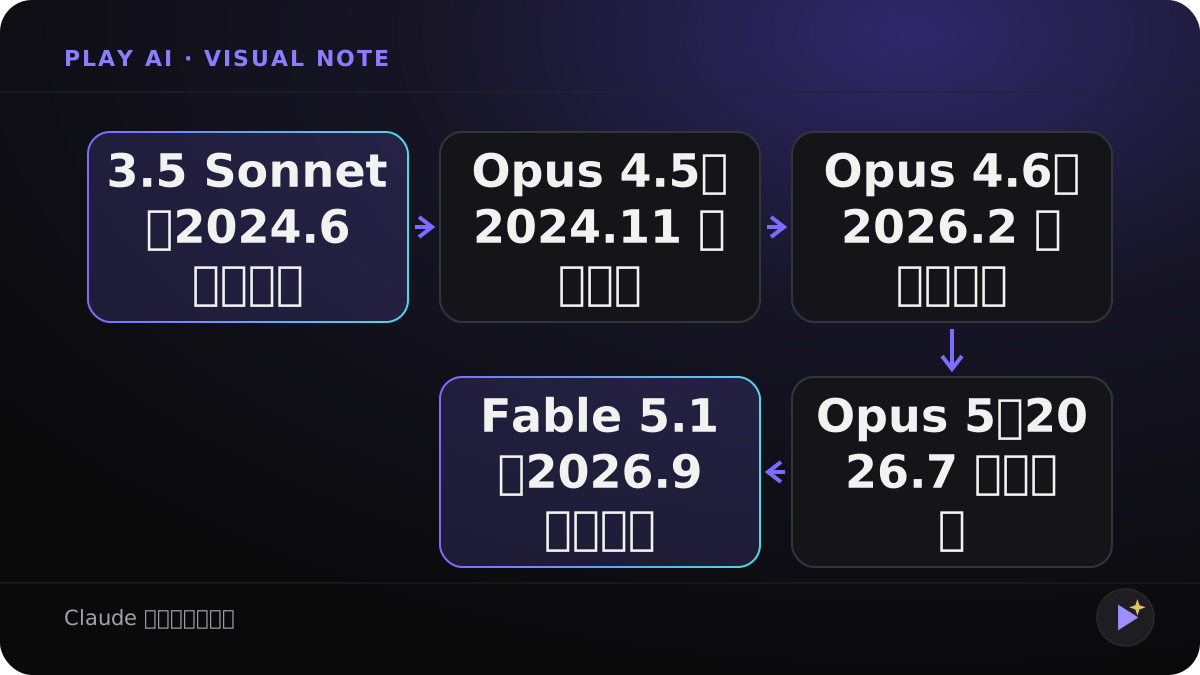
Claude Opus 5 於 2026 年 7 月 24 日發布,為 Anthropic 在該時間點的前沿文字與 agent 對手模型。 Claude Opus 4.6 implements a deliberative reasoning pipeline consisting of problem analysis, strategy formulation, step-by-step execution, and verification. Claude 3.5 Sonnet (released June 2024) outperformed the larger Claude 3 Opus in Anthropic's own benchmarks.[1][3][4]
Claude Fable 5.1 與 Claude Mythos 5.1 均於 2026 年 9 月 1 日發布,為同一底層模型的不同安全防護層級版本:Fable 5.1 為一般可用版,Mythos 5.1 僅透過可信存取計畫提供,主要面向資安與生命科學研究。 The model supports 'Computer Use' capabilities, allowing it to interact with GUIs, web browsers, and desktop applications by perceiving screenshots and executing mouse/keyboard actions. The 'Artifacts' feature, introduced in June 2024, allows users to generate and interact with code snippets and documents in a separate window with real-time rendering (e.g., SVG, websites).[1][3][4]
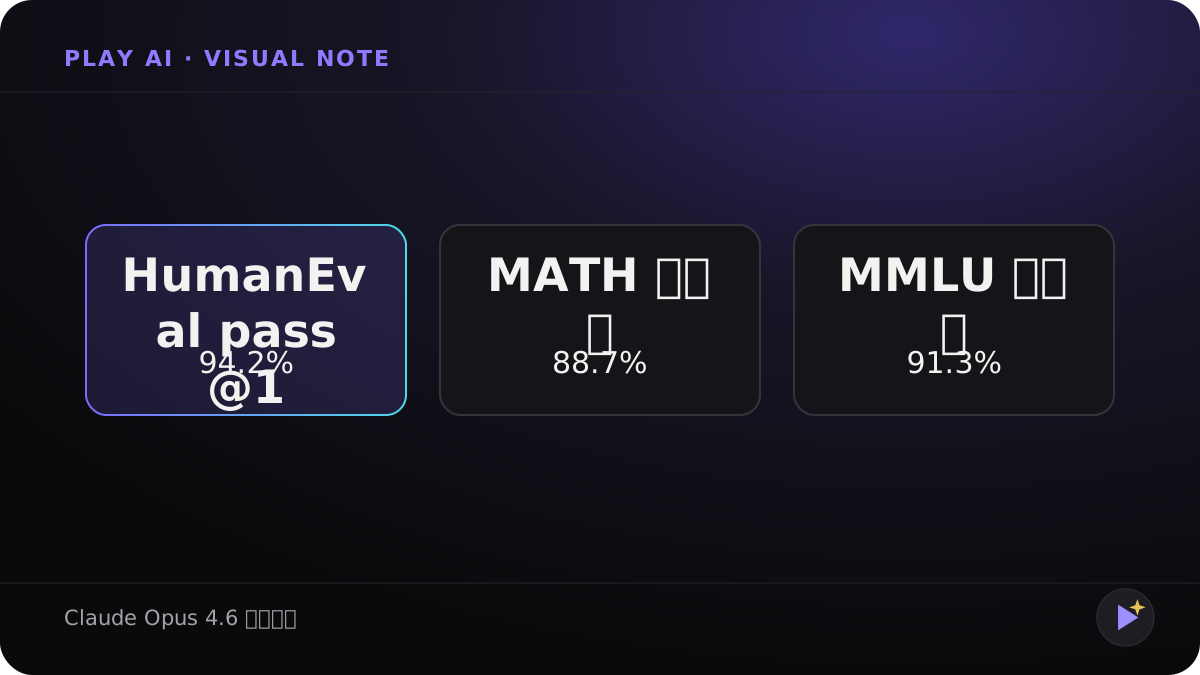
Claude Opus 4.6 於 2026 年 2 月 5 日發布,具備長上下文 beta 能力、程式開發與 agent 工作流支援,適合長文件與多步驟程式任務。 Claude Opus 4.6 achieved 94.2% pass@1 on the HumanEval Python coding benchmark. The 'computer use' feature (public beta October 2024) enables Claude 3.5 Sonnet to interact with desktop environments by interpreting screen content and simulating keyboard/mouse input.[1][3][4]
運作機制與關鍵差異
Qwen3-Max-2026-01-23 為阿里雲 Model Studio 在 2026 年 1 月 23 日的快照版本,整合思考與非思考模式,並在思考模式同時支援 Web 搜尋、Web 資訊提取與 Code Interpreter。 On the MATH dataset, Claude Opus 4.6 achieved 88.7% accuracy, with performance peaking in algebra and geometry (92-94%). Claude Code is an agentic command-line tool for delegating coding tasks via natural language; it was released in February 2025 and became generally available in May 2025.[1][3][4]
Qwen3-Max-2026-01-23 在 Model Studio 中最高支援 256K 輸入 token 長度,並按輸入長度分級計價:0–32K 為 每百萬 token 輸入 1.2 美元 / 輸出 6 美元;32K–128K 為 2.4 / 12 美元;128K–256K 為 3 / 15 美元(國際部署,2026 年 8 月 28 日價格頁)。不支援 context caching、batch inference 或 fine-tuning。 The model achieved 91.3% accuracy on the MMLU benchmark across 57 subjects. Claude Cowork is a GUI-based agentic tool for non-technical users, providing access to a sandboxed shell and local file system access.[1][3][4]
Qwen3-Max-2026-01-23 不支援開放權重下載,僅透過 Model Studio 提供託管 API 服務,無法自行部署或微調。 Claude Opus 4.6 demonstrates industry-leading performance in agentic coding, including the ability to build a C compiler with minimal human intervention. Claude Opus 4.5 (released November 2024) specifically improved performance in coding and workplace tasks like spreadsheet production.[1][3][4]
實際影響與應用
Claude 系列模型(含 Opus 5、Fable 5.1、Mythos 5.1)為閉源權重模型,僅透過 Anthropic API 提供服務,不支援自行部署或權重下載。 The model uses Rotary Positional Embeddings (RoPE) with extended frequency ranges and adaptive interpolation for its long context window. Claude Opus 4.6 (released February 2026) introduced 'agent teams' capabilities.[1][3][4]
Claude Opus 4.6 was released in early 2026 (specifically February 2026). Claude Opus 4.6 uses Constitutional AI for alignment, integrating explicit rules and values into the training process. Claude Opus 5 (released July 2026) introduced 3D rendering capabilities.[3][4]
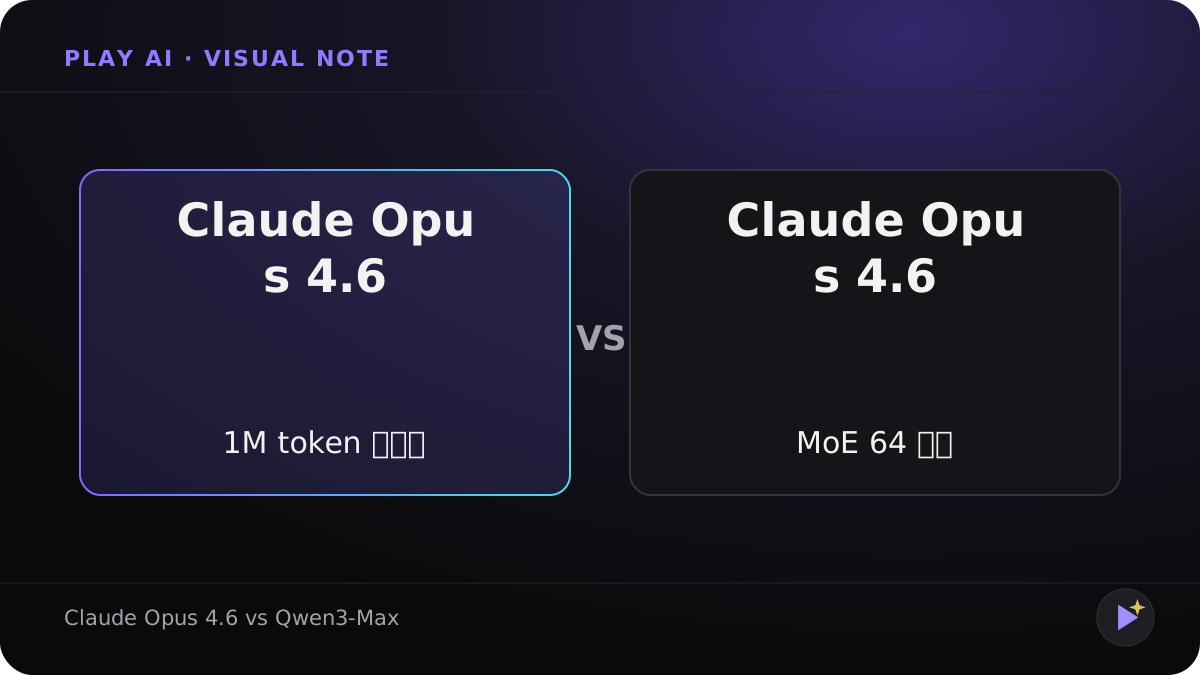
Claude Opus 4.6 features a 1 million token context window, which is a 4x increase over its predecessor. The model's vision capabilities are integrated via a vision transformer that produces feature representations compatible with the language model's latent space.[3]
限制與風險
The model utilizes a Mixture-of-Experts (MoE) architecture with 64 specialized expert networks. Claude models are trained using 'Constitutional AI', a technique to improve ethical and legal compliance by using a constitution (a document of principles) instead of relying solely on extensive human feedback.[3][4]
In its MoE architecture, while the total parameter count exceeds 300 billion, only 40-60 billion parameters are active per input. Anthropic's model tiers typically follow a three-size hierarchy: Haiku (least capable/least expensive), Sonnet, and Opus (most capable/most expensive).[3][4]
值得持續觀察的變化
The model employs a Top-k routing mechanism, activating 4-8 experts per token depending on task complexity. Claude 2.1 introduced a context window of 200,000 tokens, approximately 500 pages of text, and a beta feature for tool use.[3][4]
資料來源與延伸閱讀
以下來源用於核對本文的技術背景與關鍵事實;正文中的編號可直接跳到對應來源。產品規格與時效性資訊仍以原始官方頁面最新版本為準。
查看 9 個來源
- Qwen3-Max 2026深度評測:思考模式、工具調用與 GPT-5.6 Sol、Claude Opus 5 比較 | YOLO LAB
- DeepSeek-V4-Flash-Vision-Exp 深度評測:多模態視覺、API 限制與 GPT-5.6 比較|YOLO LAB
- Architectural Advances and Performance Benchmarks of Large Language Models in Light of Anthropic’s Claude Opus 4.6[v1] | Preprints.org
- Claude (AI) - Wikipedia
- Models overview - Claude Platform Docs
- Qwen3.8-Max 發布:2.4 兆參數、開放權重與 Agent 能力解析
- What is Anthropic Claude 4.5 and What Makes It Different | MindStudio
- Qwen4 首度曝光:Max、Plus、Flash、27B 與 5–10T 傳聞解析
- DeepSeek-V4-Pro 深度評測:1M 上下文、Agent 推理與成本比較|YOLO LAB